The Solution
How Carrot addresses the waste crisis through circular economy incentives, PAYT, EPR, and digital verification.
Physical recycling work feeds digital verification, with rewards flowing back to incentivize participation.
From linear to circular
The circular economy is a fundamental redesign of how materials flow through the economy. Instead of the take-make-waste model, a circular economy keeps materials in use for as long as possible and recovers them at end of life for reuse and recycling.
Materials fall into two broad categories, each representing roughly half of total resource consumption:
- Technical materials — Finite resources (metals, glass, plastics) that do not degrade naturally. Most can be recycled repeatedly if products are disassembled and sorted by material type. Higher recycling volumes also improve processing efficiency — for example, glass ovens running on recycled cullet operate at lower temperatures, reducing energy costs and CO2 emissions.
- Biological materials — Renewable resources (food, green waste, compostable packaging) that can be returned to the natural environment through composting, restoring topsoil and supporting future plant growth. Biological products are not to be confused with biodegradables, which are petroleum-derived and produce microplastics when they degrade.
An efficient circular economy reduces dependence on virgin resource extraction, cuts carbon-intensive supply chains, and creates new economic opportunities in recycling, remanufacturing, and composting.
Background: circular economy concepts
The circular economy draws on established frameworks. Carrot builds on these foundations to create a market-driven approach.
How Carrot bridges the gap
Many carbon market solutions — enhanced rock weathering, direct air capture, biochar sequestration — depend on complex modeling, estimation, and long-term inference. Carrot's approach is different: its digital Measurement, Reporting and Verification (dMRV) system verifies real physical events. Waste is collected, weighed, transported, and processed at an accredited facility. The data is direct, the outcomes are measurable, and each credit links to a specific, verifiable physical event.
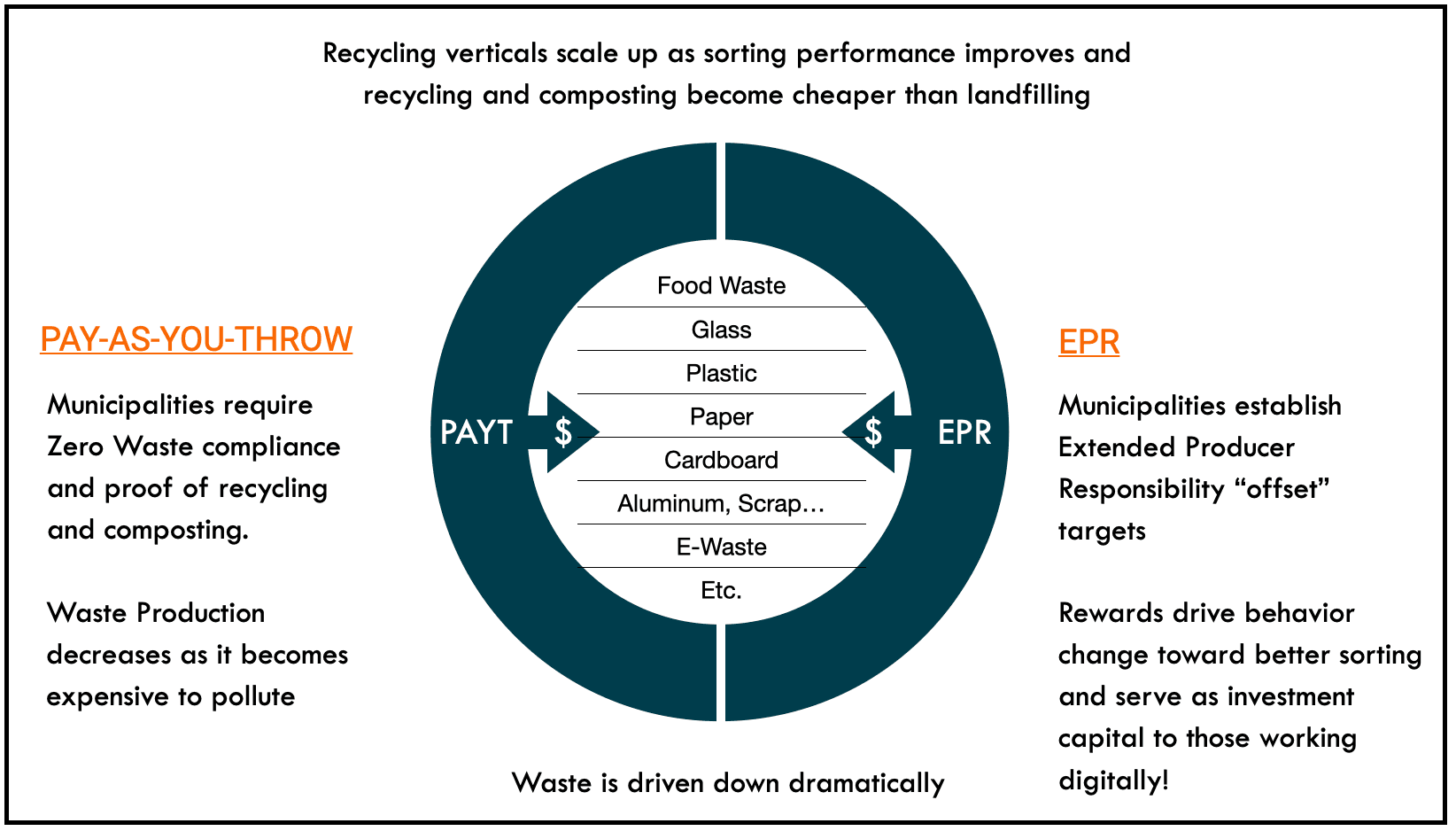
PAYT and EPR create new recycling revenues as sorting performance improves
Carrot combines PAYT and EPR with dMRV to solve the fundamental problems of trust, transparency, and fair reward distribution.
Physical waste — unlike carbon emissions — is tangible, measurable, and verifiable. Every material mass can be tracked through the recycling supply chain, from generation to final processing. The Carrot Network codifies this physical work into MassIDs, creating an unbreakable chain of custody that eliminates double counting and enables rewards to be distributed directly to all verified contributors through smart contracts.
The carbon reduction benefits of recycling and composting are well documented and science-based, with measurement frameworks from the UNFCCC, EPA WARM model, and the Greenhouse Gas Protocol. By applying these frameworks to verifiable physical waste data, Carrot produces environmental credits — Tokenized Recycling Credits (TRC) issued under methodologies such as BOLD Recycling, and Tokenized Carbon Credits (TCC) issued under methodologies such as BOLD Carbon (CH₄) — that are backed by real, measurable outcomes rather than estimates or future projections.
Proceeds from credit purchases are distributed to participants, creating a self-reinforcing incentive loop: more recycling generates more credits, which fund more recycling capacity. This market-driven approach scales participation without requiring centralized enforcement or taxation.
Read about how the system works end-to-end
Vision: closing the loop
The Carrot Network lays the groundwork for a fully circular consumer economy. As it matures, ecosystem participants will be able to build solutions that bring transparency to the entire product lifecycle:
- Proof of recycled content — Certified-recycled MassIDs can be attached to new products, enabling producers to verifiably prove recycled material content rather than relying on unverified marketing claims.
- Product composition — Third-party auditors can analyze the material and chemical composition of products and assign Product Type Identifiers (PTIs), enabling automated MassID creation when products enter the recycling stream.
- Local recyclability — Consumers can check whether a product is recyclable in their area — not only theoretically recyclable — and learn how to dispose of it correctly for local recycling operators.
These capabilities close the information gap between producers and consumers, making recyclability a competitive advantage for businesses and an informed choice for buyers.
Want to offset emissions with verified credits?
The Problem
The linear economy, global waste crisis, broken carbon markets, and the failure of existing approaches to scale recycling.
How It Works
End-to-end walkthrough of how the Carrot Network executes environmental methodologies to turn physical waste into verifiable credits and market-driven incentives.