MassIDs
Verified batches of environmental materials — the foundational data unit of the Carrot Network.
MassID Lifecycle
The complete event sequence of a MassID — from waste collection through audit to methodology outputs.
What is a MassID?
A MassID represents a verified batch of environmental materials in the Carrot Network — the foundational digital asset for the dMRV process. On-chain, each MassID is soulbound (non-transferable) and held by the Vault.
When any amount of post-consumer or post-industrial waste is identified, measured, and custody is established between two parties, a MassID is created on-chain. It records three core properties:
- Material type — What the waste is (e.g., clear glass, organic food waste, mixed plastics)
- Weight — How much there is (in kilograms)
- Chain of custody — Every participant who has handled the material, from source to recycling
MassID metadata is stored on IPFS (InterPlanetary File System), creating an immutable, publicly verifiable record of each waste batch and its journey through the recycling supply chain.
Chain of custody
The chain of custody recorded in each MassID tracks every participant who handles the material. Participants fall into six role categories:
| Role | Key | Description |
|---|---|---|
| Waste Generator | G | The person or business that produces the waste |
| Bin Custodian | B | Manages collection bins or drop-off points |
| Hauler | H | Transports waste between locations |
| Processor | P | Sorts, accumulates, or pre-processes materials |
| Recycler | R | Performs the final recycling or composting |
| Network Integrator | I | The software platform that digitizes the logistics |
Each role category can include multiple participants. For example, a glass recycling chain might involve two haulers (local collection and long-distance transport) and two processors (local accumulation center and the glass bottling plant).
Every participant in the chain of custody is identified by their wallet address and is eligible for a share of the rewards when credits are issued from the MassID.
How MassIDs are created
MassIDs are generated in three main scenarios:
1. Bin drop-off
When a user drops waste at a collection point. If the product can be uniquely identified (via QR code, barcode, or AI recognition), MassIDs are created matching the waste composition of that product.
2. Waste pick-up
When a hauler collects waste from a generator. The graduated precision model incentivizes weighing at source: generators who weigh at pick-up receive more accurate credit attribution and, in Pay-As-You-Throw programs, lower bills.
3. Drop-off at processors and recyclers
When waste arrives at a facility, the validator confirms the material content (type and weight). MassIDs in the facility's inventory are managed on a First-In-First-Out (FIFO) basis — the earliest MassIDs are processed and credited first.
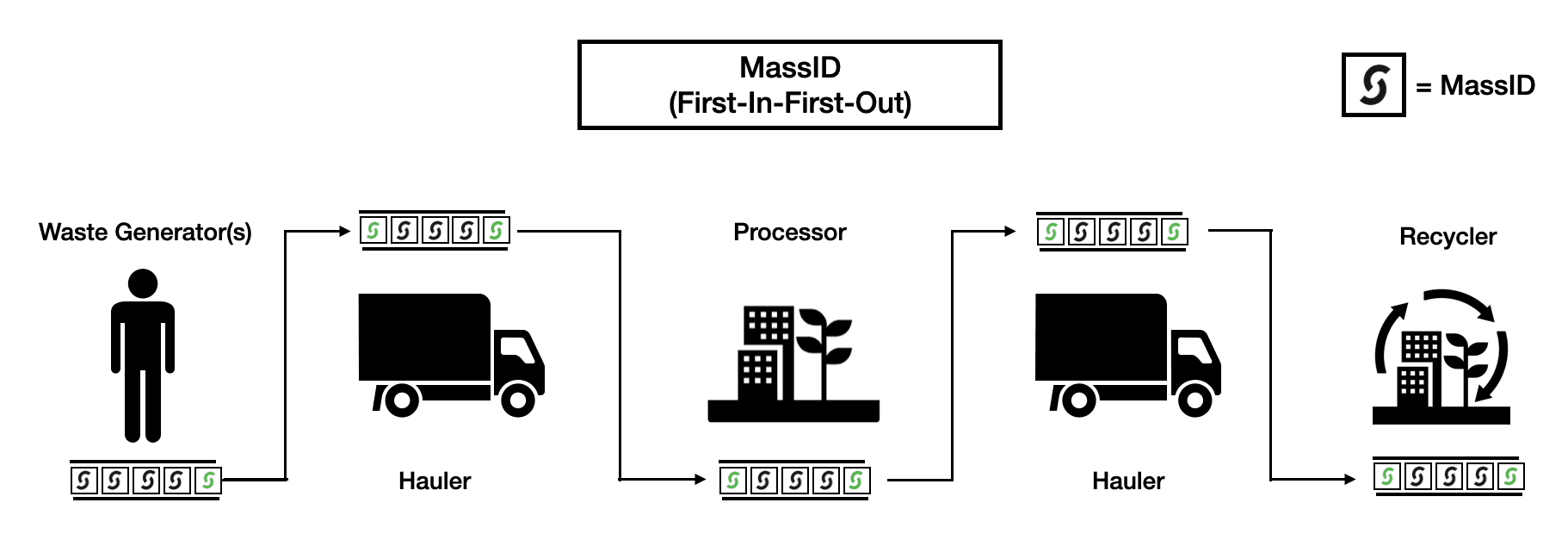
FIFO inventory management of MassIDs at a processing facility
Proof-of-Work and Provenance
MassIDs provide two forms of verifiable proof:
-
Proof-of-Provenance — The chain of custody establishes where the waste came from and who handled it at every stage, creating a traceable path from source to recycling.
-
Proof-of-Physical-Work — Each supply chain event recorded in the MassID (pick-up, drop-off, shipment, sorting, recycling confirmation) constitutes evidence that real physical work was performed — waste was collected, transported, sorted, and recycled.
Together, these proofs form the basis for the dMRV process that leads to credit generation. Only MassIDs that reach a certified recycling or composting facility, with validated chain of custody at each point, become eligible for generating credits.
This trackable digital asset is the breakthrough technology enabling the Recycle-to-Earn model — where every verified participant in the recycling supply chain receives rewards proportional to their contribution.
After a MassID passes all verification checks and is eligible for generating a Certificate, it enters the tokenization process — where its metadata is stored on IPFS and the MassID is minted on-chain.
Explorer
The Carrot Explorer at explore.carrot.eco — the public verification interface for methodology frameworks, verification rules, MassIDs, certificates, accreditations, credit purchases, retirements, and more. Distinct from blockchain block explorers.
Tokenization Process
How verified MassIDs become immutable on-chain tokens — from metadata creation through IPFS storage and minting on blockchain.