dMRV
digital Measurement, Reporting and Verification — how the Carrot Network ensures environmental impact is real, verified, and trustworthy.
What is dMRV?
digital Measurement, Reporting and Verification (dMRV) is the end-to-end digital process for executing environmental methodologies — from data capture through verification to credit generation. It represents the next evolution of the verification process needed for producing recycling and carbon credits in a transparent, trustworthy manner. The dMRV infrastructure provides the data, tools, and audit trails that enable independent, third-party validation and verification bodies (VVBs) to perform continuous, scalable verification — replacing periodic manual audits.
Traditional MRV relies on manual audits, paper receipts, and third-party certification that takes 3–5 years and costs US$250–500K per project. Carrot's dMRV digitizes this entire workflow — from data capture at the point of waste generation through methodology execution to credit generation — making verification continuous, automated, and scalable.
Carrot's dMRV system is the foundation for the Carrot Network's environmental credit markets, covering both Tokenized Recycling Credits (TRC) and Tokenized Carbon Credits (TCC).
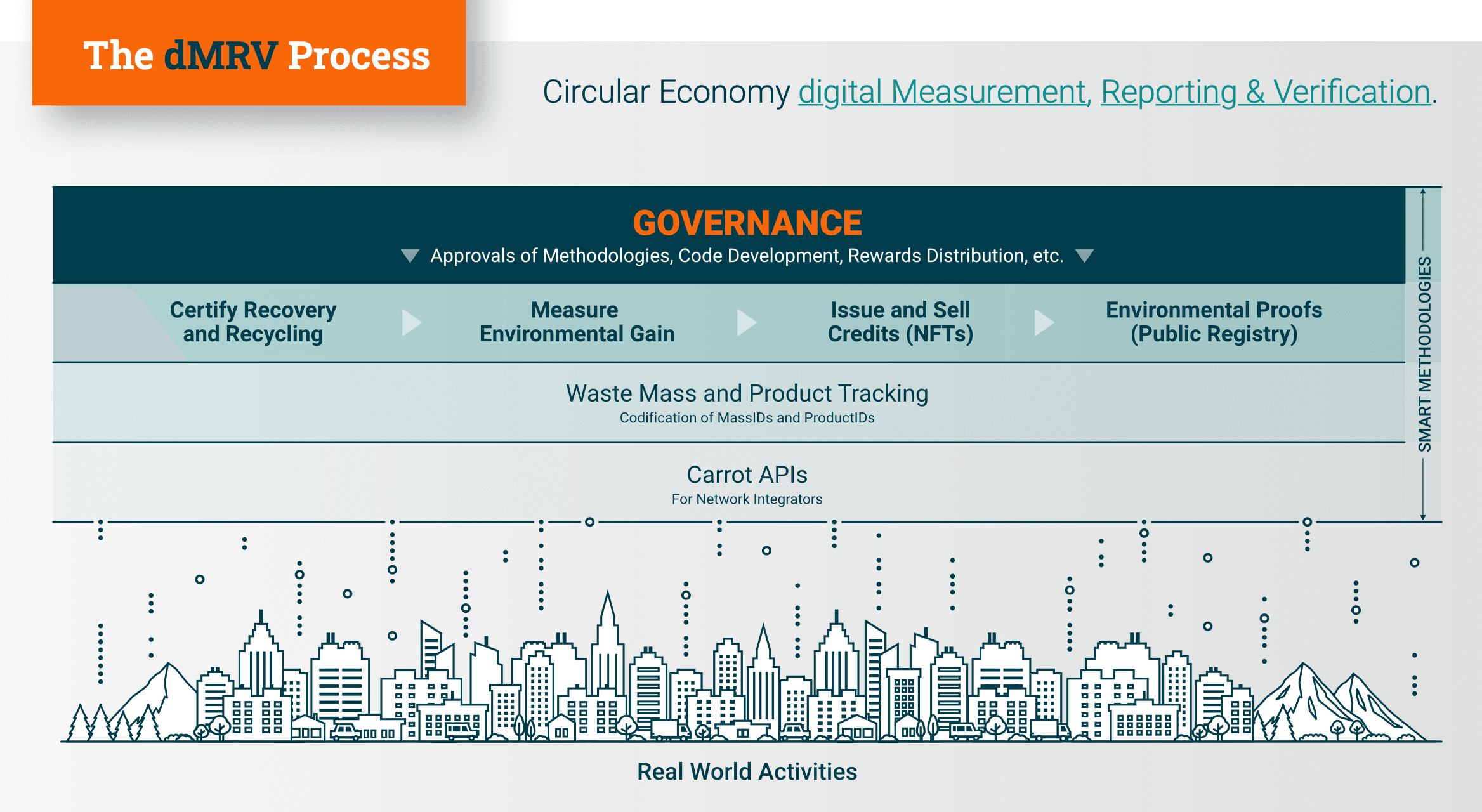
The dMRV process — from data capture through waste codification, verification, and credit generation
How verification works
Data flows through capture and codification before verification produces tradeable credits.
Separation of responsibilities
Carrot orchestrates dMRV execution — running methodology rules against supply chain data and recording verified outcomes. Independent validation and verification bodies (VVBs) provide third-party assurance when applicable. Carrot does not certify methodologies — it provides the infrastructure for their digital execution and verification.
The dMRV process follows a defined workflow:
-
Data capture — Network Integrators connect waste logistics and management applications to the Carrot Network, submitting supply chain events (hauling, sorting, recycling) as they occur.
-
Waste codification — Each batch of waste material is codified into a MassID, creating a digital record of material type, weight, and provenance. MassIDs are updated through supply chain events as materials move through the supply chain.
-
Chain of custody — Every transfer and transformation is recorded in the MassID, establishing an unbroken chain of custody from waste source to certified Recycler. This constitutes Proof-of-Physical-Work — verifiable evidence that the physical work of collecting, sorting, hauling, and recycling occurred.
-
Methodology verification — Each methodology is translated into a Methodology Verification Framework (MvF) — the specification defining rules and calculations — and implemented as a Methodology Verification Application (MvA) that automates verification. These applications confirm that supply chain data meets the methodology's requirements.
-
Credit generation — MassIDs that pass verification under a specific methodology generate Certificates (GasID for carbon avoidance, RecycledID for recycling), which in turn mint fungible credit tokens (TCC and TRC). Each methodology issues credits under its own on-chain symbol (e.g. BOLD Carbon (CH₄) issues
C-CARB.CH4, BOLD Recycling issuesC-BIOW). -
Public verifiability — On-chain activities — from minting through credit retirement — are viewable through the Carrot Explorer or any blockchain block explorer. Auditors, credit buyers, regulators, or anyone else can verify on-chain data independently.
For technical details on how methodology rules execute, see Methodology Execution.
Validators and supply chain events
Material transfers in the recycling supply chain always occur between two parties: a holder and a receiver. The receiver acts as the Validator, confirming material content (weight, quality, source) and updating the MassID through each logistics operation. The holder retains access to the validation data and can contest it.
Supply chain data includes pick-ups, drop-offs, shipments, weighing, sorting, and recycling confirmations. At each material transfer, the receiver acts as Validator and updates the MassID chain of custody, contributing to the Proof-of-Physical-Work record. For the full list of event types and how they are validated, see the Event Specification and the methodology rules (e.g. BOLD Recycling rules).
Proof-of-Authority
Proof-of-Authority (PoA) is the mechanism that ensures data integrity and trust across the Carrot Network. It operates on three levels: economic self-policing among participants, facility accreditation conducted by independent third-party auditors, and network oversight provided by the Carrot Foundation.
Anomaly Detection (CaE)
The Carrot Analytic Engine (CaE) is a machine-learning layer that continuously monitors dMRV data, detecting anomalies and suspicious patterns in supply chain data. When irregularities are identified, the system flags events for additional review or blocks credit issuance until issues are resolved. See Methodology Ecosystem for details.
Methodology Advisory (CaA)
The Carrot Agentic Advisor (CaA) is an AI layer that identifies opportunities for methodology, data quality, and process improvements across the ecosystem. See Methodology Ecosystem for details.
Why dMRV matters
Traditional environmental credit markets suffer from persistent trust problems: double counting, unverified claims, and opaque registries. Physical waste, unlike carbon emissions, is tangible and measurable — but without a digital verification system, waste-based credits face the same trust challenges. In traditional verification, a VVB agent typically analyzes approximately 2% of project data through periodic manual audits. Carrot's dMRV infrastructure verifies 100% of data related to each MassID and certificate, enabling VVBs to perform more thorough and continuous verification.
Carrot's dMRV solves this by digitizing the entire verification process — executing methodology rules against supply chain data and recording verified outcomes on-chain. The result is environmental credits backed by verifiable physical outcomes rather than estimates, projections, or paper receipts.